

Spinal Fusion Surgery in Naples, FL
Personalized Treatment for Spinal Instability
Spinal fusion is a surgical procedure used to stabilize the spine by joining two or more vertebrae. It may be considered when abnormal movement or instability contributes to back pain, nerve symptoms, deformity, or other problems involving the spinal column.
At Apex Brain & Spine, our board-certified, fellowship-trained neurosurgeons tailor fusion surgery to your diagnosis, symptoms, neurologic examination, imaging findings, anatomy, and treatment goals. Not every patient with back or leg pain needs fusion surgery. When fusion is appropriate, the goal is to improve spinal stability and address the condition contributing to symptoms.
When Spinal Fusion May Be Considered
Spinal fusion may be considered for selected patients with conditions such as spondylolisthesis, spinal instability, advanced degenerative changes, deformity, recurrent disc-related problems, or nerve compression that requires both decompression and stabilization.
Before recommending fusion, our team reviews:
● Your symptoms and how they affect daily life
● Your medical history and prior treatment
● Your neurologic examination
● MRI, CT, X-ray, or other relevant imaging
● Spinal alignment and stability
● The potential benefits, risks, and alternatives of treatment
The right approach depends on the affected spinal level, the cause of symptoms, the need for nerve decompression, your anatomy, and your individual goals.
How Spinal Fusion Works
During spinal fusion, two or more vertebrae are joined to limit movement at the affected spinal segment. In some cases, the damaged disc is removed and an interbody spacer, also called a cage, is placed in the disc space with bone graft material.
Instrumentation such as screws and rods may be used to help maintain alignment and stability while the fusion matures. The exact technique depends on the condition being treated and the surgical approach selected for your case.
PLIF: Posterior Lumbar Interbody Fusion
Posterior lumbar interbody fusion, or PLIF, is a fusion performed through the back of the spine. It may be considered when a patient needs both nerve decompression and spinal stabilization.
During a PLIF procedure, the damaged disc may be removed and an interbody spacer with bone graft may be placed to support fusion. Screws and rods may be used to maintain alignment and stability while the fusion matures.
This posterior approach can be useful when the surgeon needs to relieve pressure on the nerves while stabilizing the spine during the same procedure.
PLIF may be used for selected patients with conditions including spinal instability, stenosis, degenerative disc disease, recurrent disc herniation, or spondylolisthesis.
ALIF: Anterior Lumbar Interbody Fusion
Anterior lumbar interbody fusion, or ALIF, is a fusion approach performed through the front of the abdomen to access the lower spine.
During an ALIF procedure, the damaged disc may be removed and an interbody spacer with bone graft may be placed to support fusion. The anterior approach may be considered for selected patients based on the spinal level involved, anatomy, alignment goals, diagnosis, and need for stability.
An ALIF procedure may be performed as part of a broader surgical plan that includes additional stabilization when appropriate. The details of the approach are individualized and determined through careful review of imaging, medical history, and surgical goals.
ALIF may be considered for selected patients with degenerative disc disease, spondylolisthesis, or other lower-back conditions, with candidacy depending on anatomy, medical history, the affected spinal level, and treatment goals.
Personalized Surgical Planning
Spinal fusion is not one procedure or one solution for every patient. Your neurosurgeon will determine whether fusion is appropriate and which approach best fits your condition.
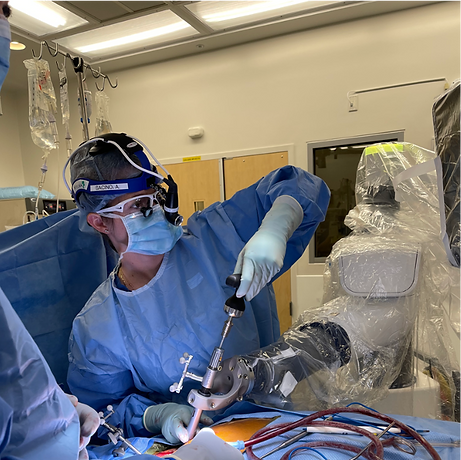
Some patients may benefit from decompression alone. Others may require fusion to address instability, restore alignment, or support the spine after nerve decompression. In certain cases, minimally invasive or robotic technology may be used when clinically appropriate.
Your surgical plan may include discussion of:
● The reason fusion is being considered
● The number of spinal levels involved
● Whether nerve decompression is needed
● The potential use of an anterior, posterior, or other approach
● The potential use of instrumentation, bone graft, or an interbody spacer
● Expected treatment goals, risks, alternatives, and recovery considerations
Fellowship-Trained Spine Care
Amanda Sacino, MD, PhD is a fellowship-trained neurosurgeon with specialized training in degenerative spine conditions, minimally invasive spine surgery, robotic spine surgery, and spine oncology.
Gregory Cannarsa, MD is a board-certified neurosurgeon with fellowship training in cranial, cerebrovascular, and minimally invasive spine surgery.
Apex Brain & Spine provides care for patients in Naples and Southwest Florida. We use detailed imaging review and individualized surgical planning to help patients understand their options.
Request a Spinal Fusion Consultation
If you have been diagnosed with spondylolisthesis, spinal instability, degenerative spine disease, or another condition that may require stabilization, Apex Brain & Spine can help you understand whether spinal fusion surgery may be appropriate.