

Minimally Invasive Spine Surgery in Naples, FL
Focused Treatment for Spine Conditions
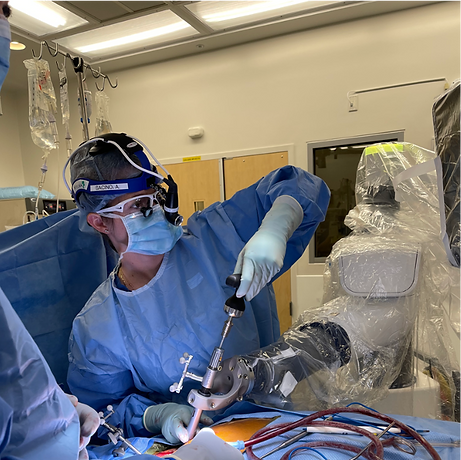
At Apex Brain & Spine, we use minimally invasive spine surgery techniques to treat selected conditions affecting the spinal nerves, discs, and vertebrae. These approaches use smaller incisions and specialized instruments to address nerve compression and other spinal problems while preserving as much surrounding muscle and tissue as possible.
Our board-certified, fellowship-trained neurosurgeons tailor each surgical plan to your symptoms, neurologic examination, imaging findings, and individual treatment goals. Not every patient needs surgery, and not every spine condition is best treated with a minimally invasive approach. When it is appropriate, minimally invasive surgery can help address the source of pain, numbness, weakness, or difficulty walking.
Minimally Invasive Laminectomy
Minimally invasive laminectomy is a surgical option to relieve pressure on spinal nerves caused by spinal stenosis, herniated discs, or spondylolisthesis.
At Apex Brain & Spine in Naples, FL, we perform this procedure through a small incision, often approximately 1 to 2 inches in length. The procedure removes only the portion of bone or ligament contributing to nerve compression.
This approach is designed to preserve surrounding muscles and limit tissue disruption. For appropriately selected patients, decompression may improve symptoms such as radiating arm or leg pain, numbness, weakness, and difficulty walking.
Minimally invasive laminectomy may be used to address spinal narrowing, disc-related compression, and other conditions causing pressure on the spinal cord or nerve roots.
See our surgical video on YouTube for an illustration of the minimally invasive ultrasonic laminectomy procedure.
See Dr. Sacino’s review on a cause and management approach for spinal stenosis.
See Dr. Sacino’s study on outcomes after surgery for cervical spinal stenosis.
Microdiscectomy for Herniated Disc
For certain herniated discs, microdiscectomy removes the portion of the disc pressing on a nerve through a small incision rather than necessarily removing the entire disc.
The goal of microdiscectomy is to reduce nerve compression and improve symptoms such as radiating leg pain, numbness, tingling, or weakness when non-surgical treatment has not provided sufficient relief or when surgery is otherwise appropriate.
Personalized Surgical Planning
Minimally invasive spine surgery is not one procedure or one solution for every patient. Your treatment plan depends on the location and cause of nerve compression, the stability of the spine, your imaging findings, prior treatment, and your overall health.
Before recommending surgery, we review:
● Your symptoms and how they affect daily life
● Your medical history and prior treatment
● Your neurologic examination
● MRI, CT, X-ray, or other relevant imaging
● The expected goals, potential benefits, risks, and alternatives of treatment
When additional stability is needed, a different procedure, such as spinal fusion, may be more appropriate than decompression alone.
Fellowship-Trained Spine Care
Amanda Sacino, MD, PhD is a fellowship-trained neurosurgeon with specialized training in degenerative spine conditions, minimally invasive spine surgery, robotic spine surgery, and spine oncology.
Gregory Cannarsa, MD is a board-certified neurosurgeon with fellowship training in cranial, cerebrovascular, and minimally invasive spine surgery.
Apex Brain & Spine provides care for patients in Naples and Southwest Florida. We use detailed imaging review and individualized surgical planning to help patients understand their treatment options.
Request a Consultation
If you are experiencing persistent radiating pain, numbness, weakness, walking difficulty, or symptoms related to a herniated disc, spinal stenosis, or another spine condition, Apex Brain & Spine can help you understand whether minimally invasive spine surgery may be appropriate.