

Spine Conditions Treated in Naples, FL
Specialized Care for Spine Conditions
Apex Brain & Spine evaluates and treats a range of spine conditions that can affect comfort, mobility, nerve function, and quality of life. Our board-certified, fellowship-trained neurosurgeons review your symptoms, medical history, physical examination, and imaging to help identify the cause of your back, neck, arm, or leg symptoms.
Not every spine condition requires surgery. Treatment recommendations are individualized and may include observation, non-surgical care, minimally invasive spine surgery, spinal fusion, kyphoplasty, tumor surgery, or another appropriate approach based on your diagnosis and goals.
For sudden severe pain after trauma, new or worsening weakness, numbness in the groin or saddle area, loss of bladder or bowel control, fever with severe back pain, or another medical emergency, call 911 or seek emergency care immediately.
Spine Conditions We Treat
Compression Fractures & Spinal Trauma
Compression fractures occur when part of a vertebra collapses or loses height. They may result from trauma, osteoporosis, spinal tumors, or other conditions that weaken bone and can cause sudden or persistent back pain, loss of height, changes in posture, and difficulty with everyday movement.
At Apex Brain & Spine, Gregory Cannarsa, MD and Amanda Sacino, MD, PhD evaluate and treat spinal compression fractures using minimally invasive spine-surgery techniques, including kyphoplasty for appropriately selected patients.
Kyphoplasty may be considered for painful vertebral compression fractures when symptoms, imaging findings, and the patient’s overall health support treatment. The procedure is designed to stabilize the affected vertebra and may help reduce fracture-related pain.
Please visit CompressionFractureClinic.com for more information about the specialized procedure room dedicated to compression-fracture care.
See Dr. Sacino’s papers on treatment of spinal cord injury: Part I and Part II.
See Dr. Sacino’s lecture at Seattle Science Foundation on new techniques for the treatment of spine trauma.
Herniated Disc
A herniated disc occurs when disc material extends beyond its normal boundary and irritates or compresses a nearby spinal nerve. Depending on its location, a herniated disc can cause back or neck pain, radiating pain into an arm or leg, numbness, tingling, or weakness.
Apex Brain & Spine evaluates your symptoms, neurologic examination, medical history, and imaging to determine the most appropriate next step. Many patients may begin with non-surgical treatment. When symptoms persist or nerve compression is causing significant problems, minimally invasive surgery may be considered for selected patients.
Microdiscectomy is a procedure that removes the portion of disc compressing a nerve through a small incision. The goal is to relieve nerve pressure and improve symptoms such as radiating pain, numbness, or weakness when surgery is clinically appropriate.
Not sure whether you are dealing with a bulging disc or a herniated disc? Read our blog about the key differences between a bulging disc and a herniated disc, and when it may be time to seek care.
Spinal Stenosis
Spinal stenosis is narrowing within the spinal canal that can place pressure on the spinal cord or spinal nerves. It may occur in the neck or lower back and can contribute to pain, numbness, weakness, balance problems, radiating arm or leg symptoms, or walking difficulty.
Lumbar spinal stenosis may cause neurogenic claudication, a pattern of leg pain, heaviness, numbness, or weakness that can develop with standing or walking and improve with sitting or bending forward.
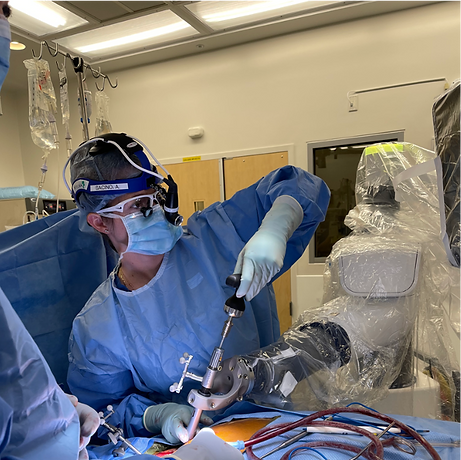
Apex Brain & Spine offers minimally invasive treatment options for spinal stenosis, including minimally invasive ultrasonic laminectomy. During this procedure, the portion of bone or ligament contributing to nerve compression is removed through a small incision, typically about 1 to 2 inches in length.
For appropriately selected patients, decompression may help improve radiating symptoms and walking tolerance. Individual outcomes vary and depend on the diagnosis, degree of compression, duration of symptoms, overall health, and other clinical factors.
See our surgical video on YouTube for an illustration of minimally invasive ultrasonic laminectomy.
See Dr. Sacino’s review on a cause and management approach for spinal stenosis.
See Dr. Sacino’s study on outcomes after surgery for cervical spinal stenosis.
Spondylolisthesis
Spondylolisthesis occurs when one vertebra slips forward in relation to another. This change in alignment can contribute to back pain, radiating leg pain, numbness, weakness, walking difficulty, or nerve compression.
Treatment depends on the degree of slippage, spinal stability, neurologic symptoms, imaging findings, and the impact of symptoms on daily life. Some patients may benefit from non-surgical care, while others may require decompression to relieve pressure on nerves or fusion surgery to stabilize the spine.
Apex Brain & Spine offers minimally invasive treatment options for selected patients with spondylolisthesis. When surgery is appropriate, minimally invasive techniques may preserve surrounding muscle attachments and limit tissue disruption. For more significant instability or slippage, spinal fusion may be considered through a personalized surgical plan.
See Dr. Sacino’s report on surgical management.
See Dr. Sacino’s review on the condition and treatment.
Spinal Tumors & Spinal Oncology
The spine can be affected by metastatic cancer that has spread from another part of the body, as well as primary spinal tumors such as meningioma and schwannoma. Depending on their location and behavior, spinal tumors can affect the spinal cord, nerves, spinal stability, and neurologic function.
At Apex Brain & Spine, fellowship-trained neurosurgeons evaluate spinal tumors and spinal metastases through a detailed review of imaging, symptoms, neurologic findings, tumor characteristics, spinal stability, and the patient’s broader cancer-treatment plan.
Treatment may involve surgery, decompression, stabilization, image-guided navigation, robotic technology when clinically appropriate, coordination with radiation oncology, or other specialized care. The recommended approach is tailored to the individual diagnosis and treatment goals.
Watch Dr. Sacino’s Grand Rounds on the latest treatments for brain and spine tumors.
See Dr. Sacino’s study on surgical management of spinal tumors.
See Dr. Sacino’s study on use of the spine robot for spinal metastases.
See Dr. Sacino’s report on intraoperative navigation for less invasive surgical management of spine tumors.
See Dr. Sacino’s comprehensive review on targeted radiation for spinal metastatic tumors.
See Dr. Sacino’s report on surgical management of sacral tumors.
See a book chapter by Dr. Sacino on surgical management.
See Dr. Sacino’s lecture at Seattle Science Foundation on robotics and augmented reality for spine tumor surgery.
See Dr. Sacino’s lecture at Seattle Science Foundation on carbon-fiber technology for spine instrumentation, tumor surveillance, and radiation delivery.
Fellowship-Trained Spine Care
Amanda Sacino, MD, PhD is a fellowship-trained neurosurgeon with specialized training in degenerative spine conditions, spine oncology, minimally invasive spine surgery, and robotic spine surgery. Her training includes minimally invasive and robotic spine surgery at Johns Hopkins Hospital and Sibley Memorial Hospital, as well as complex and minimally invasive spine fellowship training at the Swedish Neuroscience Institute.
Gregory Cannarsa, MD is a board-certified, fellowship-trained neurosurgeon with training in minimally invasive spine surgery and treatment of compression fractures through minimally invasive balloon kyphoplasty.
At Apex Brain & Spine, our neurosurgical team uses a personalized approach to evaluate the cause of symptoms and recommend the least disruptive treatment path that is medically appropriate.
What to Expect at Your Spine Evaluation
Review of Symptoms & Imaging
Your appointment may include a detailed review of your symptoms, medical history, prior treatment, physical examination, and relevant imaging. We review imaging with you and explain the findings in clear terms.
Personalized Treatment Planning
Not every patient needs surgery. When surgery may be appropriate, your neurosurgeon will explain the reason for the recommendation, potential benefits and risks, alternatives, and what to expect throughout treatment and recovery.
Coordinated Care
Apex Brain & Spine provides care for patients in Naples and Southwest Florida. Our physicians treat patients at Physician’s Regional Medical Center. Appointments may be available on an expedited basis when appropriate.
Explore Spine Treatments
Apex Brain & Spine provides advanced treatment options tailored to the individual patient, including:
Request a Spine Consultation
If you are experiencing ongoing back, neck, arm, or leg pain; numbness; weakness; walking difficulty; or symptoms related to a diagnosed spine condition, Apex Brain & Spine can help you understand your options.